Brain: Part 2

There was always going to be a part 2, even if every thought and action for 3 years was aligned against that inevitability being a possibility. All of us, including him, knew the statistics with a glio-bastard-oma, but life is still to be found in the shadow of death, and I’m at peace knowing that, for the most part, we lived. What I want to do is document the whole process, in order to put something into the information ocean that might be a bit useful for someone else going through a glioblastoma diagnosis.

The Beginning:

Beginning in February 2021, my Dad was officially diagnosed. He was complaining of a headache he attributed to falling while snowboarding the week before, and was noticeably worse at texting, speaking, and installing electrical wiring throughout the house (its a small miracle nothing too shocking came about). After his speech was seriously mumbled, my family was sufficiently worried enough that they decided to bring him into the ER, where a brain scan revealed a tumor the size of a tangerine in his right prefrontal lobe. Tests confirmed that the tumor was un-methylated (about a 2 in 3 chance) meaning some drugs wouldn’t be as effective against it.

An emergency craniotomy followed, but follow-up scans revealed the first surgeon left large amounts of tumor in place. After meeting with another surgeon who promised to remove more, my dad underwent another craniotomy days after his 62nd birthday. This time, the surgeon was able to remove much more, resulting in virtually no tumor being detected. A huge win, and something that not all glioblastoma patients are so lucky enough to achieve. Still, we all had the knowledge that just a single cancer cell could re-grow the entire tumor, most likely elsewhere in the brain that is less operable.

After a recovery period following back-to-back brain surgeries, he began radiation treatment at one of the premier cancer centers in the country. The radiation was designed to zap any tumor cells still present in the original area, preventing the single malignant cell from forming a re-growth. Throughout this period, my Dad absolutely retained his personality, never for a second losing his sense of humor at doctor’s appointments, with his many friends who came to visit, and with us. I think that part of him wasn’t in his brain, at least not totally. At his core, he was a person who rebelled against “roles,” or the part he was expected to play in social situations. He would make jokes constantly as if to uncover a deeper truth behind the defining Human experience of falling ill and changing for the worse. Or maybe it was purely for the benefit of us around him, but I think it was a little bit of both.

The Middle:

Thankfully, my Dad had began working for a local company with great benefits, and had continued to pay into long-term disability insurance after seriously considering cancelling. So what could have been a crippling situation financially was avoided. After the craniotomies and radiation, he was weaker and required more naps, but overall was still able to walk around the house, eat prodigious amounts of food, and complain about the puppy the family we (insanely?) adopted to help with his recovery process. The dog had the effect of certainly bringing life into the house, but resulted in my Dad doing the lion’s share of the care and exercise while I and the rest of the family was at work.

The summer and fall of 2021 passed quickly–my Dad was alert most of the time, and was almost back to his former self. Physically, Dad was able to ride his bike, do house/yardwork, and travel, and even began returning to work on a part time basis by the end of the year. There were no signs of the cancer returning, he was doing well, and we were happy if apprehensive about what the future might hold with its wicked probabilities. At any moment, the Dad we lost and rediscovered, could slip away again, creating a perpetual state of anxiety, denial, and often macabre humor on my Dad’s part.

During that half of 2021 and the year following, we were engaged in a combined arms operation designed to limit the resurgence and expansion of any renewed tumor growth. Knowing that a single malignant glial cell could cause the tumor to return, we tried practically everything to prevent this eventuality. I say “combined arms” because, like the military term, our offensive consisting of multiple, mutually supporting areas of diet, naturopathy (homeopathy), and state of the art immunotherapy which I will expand below:

Diet

Books such as Grain Brain: Eat to Beat Disease, and Blue Zones Kitchen were always scattered around our kitchen at the time. Each approached the subject of disease in a slightly different way, but largely agreed on several key areas:

1. Cutting out all added and refined sugars that might cause a blood glucose spike. The idea being this would cause a tumor cell to gobble up glucose and go through horrifically fast periods of mitosis that could outpace radiation, immunotherapy, and other counter efforts.

2. Adopting a gluten free diet, the idea being that gluten could result in a similar spiking of blood sugar, but admittedly this connection is less clear in my mind and I will update if any clarifying information comes my way on this (thanks mom!)

3. Cutting out alcohol, as (what was new to me) it is a known carcinogen! Who knew right? I’d have thought someone would have told me this at some point! https://www.cancer.gov/about-cancer/causes-prevention/risk/alcohol/alcohol-fact-sheet

4. Maximizing anti-cancer compounds naturally occurring in foods, namely berries, cruciferous vegetables, and garlic that are all shown to be highly anti-carcinogens (So if I drink a beer and chase it with a handful of blueberries, I should be good right?)

Naturopathy:

Naturopathy, or homeopathy uses dietary or topical supplements that might otherwise be ignored or derided by conventional medicine. As I see it, the field runs the gambit from science-based testing to determine nutrient deficiency (which they always conveniently also happen to sell) to borderline hilarious “testing” involving finger snapping, thigh slapping, astral projections about what your body is “asking” for. The placebo effect is a powerful one however, and many folks who engage in these treatments actually get better, more of a testament to the power of the mind-body connection than any physical substances ingested in my opinion.

Nevertheless, what might seem ludicrous under normal conditions to most people takes on a different light under more desperate conditions. After all, who really knows 100% of what’s going on inside our bodies, especially with a sword of Damocles suspended over one’s head? My Dad began seeing a local naturopath who prescribed treatments which thankfully appeared to pass the BS test. He was provided with a gargantuan amount of vitamins to eat each day, the majority of which consisted of Reshi mushrooms which also have demonstrated anti-cancer properties. Along with other vitamins, his bloodwork was being closely monitored by the naturopath for such things as white blood cell count, platelet counts, and red blood cell oxygen uptake. At the practical level, this created a regimen of dozens of pills each day at each meal, along with his conventional medications. To help him out, we would individually open the mushroom capsules and pour the contents into a cup of hot water, making a sort of earthy (and quite smelly) tea to a dozen or so pills he would have to swallow.

Immunotherapy:

Today is an exciting time for the science of immunotherapy, or the manipulation of the body’s own immune system to fight diseases. Dad joined a clinical trial designed to create a “most wanted” poster of a resurgent tumor cell for his immune system, as the body naturally fails to recognize cancer cells as an incipient foe to be attacked on sight. By obtaining a sample of his initial tumor cell, creating an injectable vaccine personalized from each, and reintroducing it into the body, the immune system will ideally be alerted to the threat and be forever on the lookout for regrowth. Combined with radiation, surgery, diet, and naturopathy explained above, this was truly a situation of throwing truckloads of spaghetti at the wall to see what sticks (https://www.economist.com/science-and-technology/2025/01/01/cancer-vaccines-are-showing-promise-at-last).

The End

At stick it did, for a lot longer than usual at least. Half of all patients with glioblastoma don’t see the 14 month mark from initial diagnosis, and at least half of those survivors don’t make it to 28 months, and so on. My dad fought for almost 31 hard, joyful, heartbreaking, beautiful, excruciating months and I’m so so proud of him. If I know him, I know he was fighting for my mom, sister, and I. To continue being the husband, father, and future grandfather we still needed him to be. To prevent the cruel theft of someone who saw the world differently than anyone else I know and shared it with others as a gift more precious than I can explain.

In the summer of 2022, a monthly scan revealed the tumor had returned. Small, almost undetectable. Almost. But there it was, a tiny speck of white on a Rorschach test containing 63 years of memories, love, and laughter. Just as an atomic mushroom cloud springs from a tiny amount of uranium, so too did the glioblastoma begin its counterattack.

Targeted radiation beams on the spot followed his diagnosis, which Dad tolerated pretty well, his only symptoms being fatigue and a localized sunburn. However, this had little to no result. As 2022 gave way to 2023, we saw small changes throughout the house to adapt to my Dad’s slow loss of functions. First it was a cane against the door, then a walker for stability, then a platform under his left slipper to make dragging his right food behind easier.

Yet there too was life in this year. My Dad got to meet the love of my life, we had endless family and friends come through to say hi (and I expect, farewell), and the caregiver routine commenced for my mother, sister, and I. The Hoya Lift and Stair Chair additions were memorable adds, along with my new appreciation for the battle between wheelchairs and small pebbles and steps on the way to medical appointments or therapies. As the summer came and began to depart, so too did my Dad’s ability to eat, communicate, and sit up on his own. For the final months, we were in charge of dressing, feeding, washing, comforting, and moving him around the house.

It is my hope that at this point my Dad was unaware of most of what was going on around him–I wish he could not see how this vibrant, energetic, magnificent soul was being encased in his own body. But I suspect his was more aware than we could realize, and was probably struggling internally with anger, fear, sadness, and anxiety that he was unable to express physically and emotionally. I think above all he resented being a burden to us, even though years ago he would joke about having my sister and I take care of him in his advanced age (to which I would reply that we would put him in a retirement home long before THAT!).

We decided to engage hospice care services at the end of August, where they would come and consult for ways for us to make him more comfortable as he slipped further and further away. By that point, he was largely unable to leave bed, and was sleeping a large amount of the day. I found this (https://www.brainhospice.org/brain-cancer-hospice-symptom-timeline) resource that describes the different stages of the dying process, and throughout the summer I was vigilantly looking for the signs that might give an idea of how close to the end he was. I don’t think I would recommend this, as there were serious ups and downs that would severely affect my mood and mental state.

Finally, one day in September, the hospice nurse finished her inspection and noticed mottled skin around my Dad’s arms. This, she said, was the hint that the end was only about three days away. I was astounded by the empathy that she and the other hospice personnel showed my family and I through the final weeks–I wondered how there could possibly be any empathy or emotions left to express when faced with death every day? Nevertheless, the hospice nurse cried with us as we prepared for the dreaded day. A week or so before, he quietly whispered to his in-home helper that he was seeing angels flying in the corners of his vision as the dying process began.

On September 15th, 2023, my Dad was surrounded his family as he passed on. We sang hymns and told stories as his breathing became increasingly labored between morphine doses, Led Zeppelin’s Stairway to Heaven being one of the final songs that I will forever associate with this moment.

At his funeral, I wrote his eulogy, which I think encapsulates the incredible person my Dad was to me and everyone who knew him:

The amount of people here today speaks to how incredible my Dad was at being a friend, colleague, brother, son, husband, and father. If you knew him, I think you would agree he always saw the world just a bit differently than everyone else, almost as if he knew something we didn’t about the secret to a happy life.

He manifested this perspective in a thousand little interactions he had with us as children that Hannah and I will no doubt pass on. To get us upstairs and ready for bed each night, he challenged us to a round of hide-and-go-seek upstairs and then we raced competitively to see who could get their pajamas on and teeth brushed the fastest. He was an absolute genius.

Dad had the ability to rock New Balances, tall white tube socks, and thirty-year-old Harvard T-Shirts while still somehow being cool. No doubt our pre-school remembers the Ford pickup that would arrive every morning, blaring Pink Floyd with two small children clambering out. Childhood friends of ours might remember him as the boat driver on Chebacco Lake that would whip us around in a tube, or rather we would remember if we didn’t all get so concussed. Dad’s coolness translated into a sort of pushing-the-limits energy, causing other parents to warn “Don’t Follow Scott” as the ultimate rule when snowboarding, mountain biking, or hiking. We always followed him anyway, as he led us down double-black diamond ski runs with more ice, rocks, and New Yorkers than actual snow.

Despite all this, he was a man at profoundly at peace with the world. His presence could instantly calm; a bad day could be reversed with his smile, and a goofy joke was always on stand-by. Our Dad had an incredible talent for sitting back, watching the world, and finding the humor in everything. He’d primarily demonstrate this by adding a joke in just the right point in a conversation to reduce a whole room to tears of laughter, none more so than my Mom. He just wanted people to feel good, to be a bright spot in the day of those he treasured most. He was a giver.

When my sister and I were small, and indeed there was such a time I was small, he would read to us every night. One of our favorites was “The Giving Tree” by Shel Silverstein, a story I used to think was a cautionary tale of selfishness. But I now know he was really teaching to me the true meaning of fatherhood. For those unfamiliar, there once was a Tree who loved a little Boy. The Boy plays with the Tree every day: running, climbing, swinging, pretending. The Boy loved the Tree very much and the Tree was happy.

But the Boy stays away for a long time and the Tree was sad. When the Boy comes back, the Tree shakes with joy and says “Come Boy, climb up my trunk and swing from my branches and be happy once again.” I’m so happy that I did, and we were for over two years. At the end, the Boy is old, and the Tree no longer resembles its former self, having given everything to the Boy. It apologizes for having nothing left, to be unable to play in the forest, but the Boy realizes what a gift it is to simply be in its presence, to sit with, to rest, and enjoy its company until the end.

One of my Dad’s favorite shows we watched together during his cancer treatments was “The Good Place,” a show chronicling the personal growth of a group of truly reprehensible characters who have died, entered purgatory, and are trying to make amends to enter Heaven. During its last episode, a character is preparing “to go” to the Good Place, even as it means leaving their friends behind.

He asks his distraught friend to picture a wave in the ocean. You can touch it, measure it, and admire how the sunlight passes through. But the wave crashes on the shore and is gone. But the water is still there. The wave was just a different way for the water to be for a while. The wave returns to the ocean, where it came from, and where it is supposed to be.

So my Dad is still here, all around and within us. In our sunset skies, freshly fallen snows, and our memories. To paraphrase Hemingway, someone is not gone from us while they live on in the stories we tell each other. So let us talk about the memories of my Dad so that amazing one-of-a-kind man will remain alive in our hearts. And when we look up and notice the beauty in the world that surrounds us, the beauty he saw in it, let us give thanks for having gotten the chance to know him, that magnificent wave, my Dad.
Shoes

I threw out your shoes today

You don’t

Need them.

The clatter of the dumpster floor

Echoes.

They, fated to rest in landfill,

Took you so many steps

Until your last.

Holding onto them with

First hope, then

Ripping Grief

Now you walk with me, but

These will never.

You don’t

Need them.

On Writing: Or Not

Is there anything more cliché than the person who starts a blog and declares to himself “I WILL write every week”? A flood of ideas fills the mind for posts; every book, show, car ride conversation, and current event beckons one to start typing away to uncover the core messages, broadly applicable themes, and life lessons. Sadly, similar to the person who joins a gym after the new year, the writer is aflush with something called “Motivation” which, like other fickle phenomena, is known to wax and wane at the slightest disturbance of daily energy and time commitments.

The consistently productive among us must therefore rely on Discipline, Motivation’s plodding, slavish sibling. Where Motivation injects energy and passion with irregularity into a whole host of activities, Discipline is myopic and slightly irrational–if you REALLY wanted to accomplish something, wouldn’t you WANT to do it? This difference highlights the difference between varying levels of cognition: the high-minded, idealistic, well-intentioned part of us that would like to BE a certain version of ourself, and the day-to-day creature that, after a long day, seeks out only creature comforts somewhere near the base of Maslow’s hierarchy.

So the running shoes stay in the closet, the vegetables ickify in the fridge, and the website remains, alas, un-updated. But this too, in its own way is cliché. Bemoaning the human race’s ability to make goals and stick to them has been covered in literature, psychology journals, and Tony Robbins presentations. If we’re looking for solutions to this, there is no shortage of tips and “life hacks” to put ourselves in the right frame of mind to foster discipline. From “Make Your Bed” to “Start With Why“, there are no shortages of ways to “change your paradigm” or “practice the small actions” that snowball into massive life changes. Unlocking this secret within each of us is not only a billion dollar industry, but also a method to wrangle the wild mustang Motivation, break it, and harness its raw transformative power into the workhorse Discipline.

Everyone that successfully tames Motivation into its stolid steady-state sibling (alliteration is fun isn’t it?) finds that it isn’t so easy to keep in the saddle. On cold mornings, hectic days, and energy-depleted nights, working towards a lofty goal seems at once trivial and impossible. It would be so easy to just NOT do the Thing, to mindlessly scroll through TV, social media, or, go out with friends. Perhaps the secret to Discipline is, then, self-manipulation.

A YouTuber I highly recommend, CGP Gray, has a wonderful video called SpaceShip You” where the speaker imagines a sort of Wheel with two sides as shown below:

Both sides of the Wheel will, when pushed on either side, begin the turn, thus causing a beneficial effect on both, no matter which end feels the initial “push”. As Gray points out, it is often muuuuch easier to focus on the Physical to generate positive motion in the Mental, although I suppose there might be some among us that can simply will themselves into accomplishing physical activity…those people are definitely unicorns! But either way, the positive feedback loop develops, and Discipline comes easier and easier until a disruption ultimately causes the wheel to grind to a stop. Maybe that’s where our friend Motivation comes along, to provide an initial push to get Discipline back online?

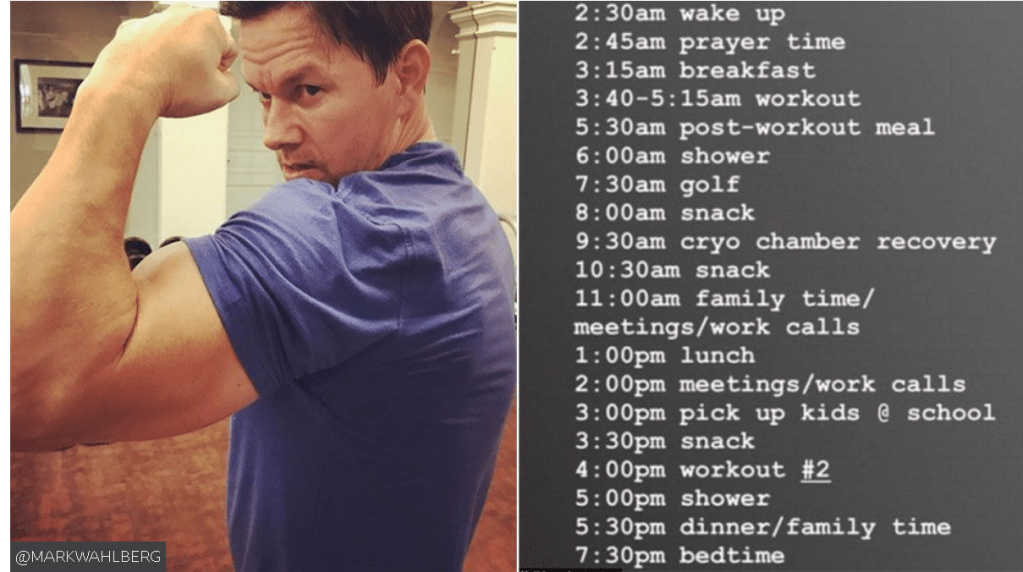
I think I’ve stumbled upon as good a conclusion as one could possibly hope in this sort of topic. Hell, I guess even finishing this post after 4 months of silence might be conclusion enough! But maybe the take away here is this: its OK to lose Discipline and fall off the horse (so to speak). We can’t always be Mark Wahlberg in terms of routine:

As far as I can tell, this is his ACTUAL routine [insert exploding head emoji]

Maybe that process is the real “Human Condition” oft spoken of in literature. Instead of us being fated to endure a certain amount of negotiable and non-negotiable suffering in this madhouse situation called “existence”, maybe the REAL Human Condition is taming the wild beast that is Motivation into Discipline, falling off, and mastering the Wheel to get ourselves back on track. We do this a thousand or ten thousand times in a lifetime and, if we’re lucky, collect a lot of self knowledge along the way. Maybe that’s the true answer to a question that has vexed philosophers since Socrates (and is how my friends greet each other): “What is Good”? Rather than being the attainment of perfection, and being done, it is the act of striving to be a better version of oneself despite knowing that set backs are constant, inevitable, and happily, recoverable.

On Running

Its funny that the act of going for a run makes you want to write about it later. Actually, since I haven’t written on ANYTHING since I think February, running somehow makes one want to spew their thoughts on a page to memorialize them (a post on Not Writing is definitely coming after this).

Why is it funny that running makes you WANT to write about it? Because it SUCKS. Why would any sane person want to go back and relive their run, when all they wanted to do while on the run is stop and be finished? A quick glance online shows that I am not alone here. Runners of every nationality, age, gender, and distance all putting their thoughts onto paper (or electrons) for the world to see. It might be tempting to dismiss this as runners casually being like: ” Yeah, I run, I’m pretty fit and stuff and I have my life all together, isn’t that awesome FOR ME?!?!1!”

Yes, it is awesome for you, but that’s not why I think we like to talk and write about running and the voluntary torment we put ourselves though. I think its something more. At this point I could get into the Science Behind Running or something analytical about the process; about how it makes your neurons fire and you become like Bradley Cooper in Limitless when he takes that pill that allows him to use 100% of his brain all at once (I’m pretty sure that business about only using 10% of your brain is baloney).

No, I’m not going to write about the Bradley Cooper experience, scientifically at least. That’s cognitively interesting (I think) but its not what we want to read or write about deep down. What’s interesting to me is how the world seems to physically alter during a run.

Community

The running experience is not a solo endeavor. I don’t think I’ve ever ran a run (that’s fun to say!) without seeing a fellow runner on the path or street or beach. As you run up to them, or awkwardly overtake them from behind, you first size them up. 9 times out of 10, at least around here, its some older lady in her 40s or 50s that DEFINITELY just finished training for Boston or Chicago or something and they run ridiculous distances for fun after waking up at 6 am on a Sunday. I’m never going to be like them, and that’s OK.

Anyway, I digress, what happens next when you see another runner is you notice their SPEED. “Are they going faster than me?” Should I try and keep pace with them?” “Would it seem like I’m trying to chase them down in some slowed-down murder show that Netflix would sponsor and turn into a series called The Slow Stalker? Oh crap, it probably would, I should slow down as to not make it weird”.

Fundamentally, its about saving face for me at least. Pride is definitely not absent in a run, in fact it is the SOURCE of the run. Running is hubris, running is foolishness. So you pick up the pace when they see you, as if to show them that you are worthy of this foolishness, this hubris, and that you rightfully earned the vaunted title of Runner (TM).

What breaks you out of this bizarre pissing-contest is the most beautiful of things. You look at each other (no sooner than 3 or 4 paces apart, anything more is weird, anything less is shifty and makes you look like youre trying too hard) and you do the Thing. The Thing can be many things, but it usually takes the form of a weird hand-splayed-out-to-the-side wave or a head nod. I’m a big believer in the head nod, I like to think it makes me look like I’m super focused, like I’m actually in the middle of a montage when I’m training to beat the Russians in the next boxing match a la Rocky III. A head nod Up is for people that seem like they need a friendly sign of encouragement, a head nod Down is for everyone else to know that They’ve Got a Badass Over Here (cue NDT meme from 2011).

That micro interaction is awesome. Theres no better way to put it than just a pure show of friendlieness and community. You are all out there TOGETHER doing this thing together that none of you really HAD to do, but you wanted to in your morning hubris. Now you are together reaping what you sow, in some circle of Hell that involves the running app speaking through your headphones that you’ve crossed some arbitrary point in this strange dimension of pain where time does not flow as normal. But youre doing it together! In this day and age, is it weird to say thats probably the most pure, supportive sign I see from complete strangers on the street? I guess when I walk my puppy people are friendly, but then again, thats not really directed at me haha.

DISTANCE

Oh boy. “How tough do we think we feel today, huh? Biiiiiig man wants to run some Big Distance, is that it?? You think youre TOUGH enough to handle this brah??” -My Shoes, first step outside.

No where is the running hubris more evident than the distance selection portion of the pre-run antics. You might pull up your running app, or mentally stare at a wall and think “yeah, that’s about X Miles, I did it like 3 months ago, what’s the big deal?” And you sign yourself up for X Miles like a fool. I’ve found that most runs seem to go like this:

Mile 0-1, Denial: Trot, trot, trot…weeee! This isn’t so bad! Oh HI Mr. Shoes, isn’t it a LOVELY day out? Thanks for being so bouncy and helping we wizz through this run! Oh boy, this will be a snap! (I like how I revert to a 1960’s teenager with my sayings when I’m enjoying the run) I wonder if I should go MORE? Am I selling myself short? Am I actually in fantastic shape and no one told me? I should speed up and really keep myself on pace to hit a PR!

Mile 1-2, Pain and Guilt: Haha, oh man, well this is cool. Should I go down that street or will this one carry me far enough that I can hit my distance goal without having to run past my house again in shame? Hm my knee is making itself heard a little bit, and I’m starting to get kinda sweaty…UGH why did I spend all week eating like crap? I should be feeling SO much lighter right now!

Mile 2-3: Bargaining: Okay, if I keep on this pace, I’ll be too tired at the end, let me throttle back a bit, then I can just carry on right to the end! This kinda sucks. I don’t want to do this anymore. Hey, did you hear me? I want to get off! Can we at least walk for a bit? C’mon, no one is coming, no one’s gonna know that youre a Quitter. Ugh, why won’t you listen to me???

Mile 3-4, Depression: F@#$, this feels like @#$. You’re a fool, Adam. What makes you think you can do this distance? Remember when you spent all day yesterday watching Netflix and cruising Reddit? You also sit all day at work, you really think you can just get up and run all that way? Pff what arrogance is Man!

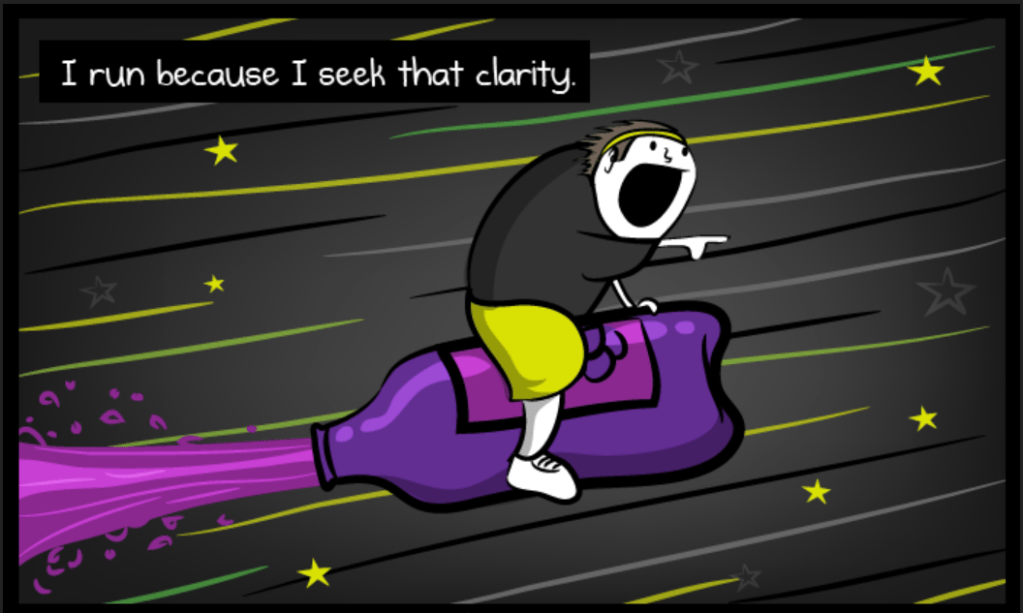
Credit: The Oatmeal https://theoatmeal.com/comics/running

Mile 4-rest of the way, Upward Turn: This is the part where you get a second wind and you feel awesome! Let my feet carry me to VICTORY! I LOVE running, I’m a RUNNER! Resignation & Hope: No, this has never happened to me, and I’m not sure it ever will. And thats okay. I am not one of the chosen few for whom this will be an easy thing, just like my Mom has been telling me for 27 years. Us folk are not runners, and thats okay. Oh crap, we’re almost done?? Fo’real??? Hell yeah, lets hit the Gas. Is that my street?? Oh yusssss, I can just finish and then have lunch and a cold shower and then I’ll have the best weekend EVER! Is that my driveway down there? It IS!! AHHHHHHHHHH (fin).

Post Run

Right after a run, everything seems possible. Once you shower (or rather during if you’re like me) you think of all the things you’ve been meaning to do, all the people that you need to text or call to catch up with, different ways you can be a Better Human (TM). And maybe you do one of those things, maybe you write a blog post you’ve been neglecting for months and months and months, maybe you call up that friend and learn whats going on in their lives? Maybe what that run has given you is more than just blisters, sore joints, and sweat pouring into your eyes, making them sting. What the run gives you is honestly hope. Its a vehicle for transforming hubris into actions that make you a sliiiiiightly better person. Like a Benedictine Friar self-flagellating away in an abbey, running (afterwards at least) is a strangely spiritual experience, a blast furnace that takes sweat and self-defeating talk and emotion and transforms it into Clarity.

Credit: The Oatmeal https://theoatmeal.com/comics/running6

Final thoughts: I actually wrote this before I checked out The Oatmeal’s awesome comic on running. I read that comic way back in like 2013-14 but after seeing his overall takeaway from the Running Experience (I actually used the clarity word before I saw this last panel!), it made me realize that my experience is not original, and that’s OK. Running isn’t an original experience, we all run from the moment we can walk pretty much. All of us raced around the playground at Recess, all of us ran to our parents or friends or ice cream truck as children, the only difference is that some people stop running at some point. We’re born to run as people, its part of the human experience! I won’t get into the research on how our ancient ancestors used to run as our primary hunting mechanism, but I like to think that running is a part of our inheritance or, more accurately, the post-run clarity we experience after doing something hard is something like hope, the only real, amazing human quality that has endured in eons of human experience across all sorts of trials and tribulations (can you ever have a trial without a tribulation??)

That’s why running is cool, and that’s why I’ll keep running even though I suck, it sucks, and no one in their right mind should do it…it makes me feel like I’m progressing to better things. And if I have to get blisters and aches and sweaty to feel that way, so be it.

Brain: Part 1

The news hits you hard, out of nowhere. You might have been seeing some changes for a while now, telling yourself that it was just aging, just ennui manifesting itself in a year marked by the turning of pages on a calendar and little else. But there It is, right in front of you, unable to be negotiated with or mitigated or put aside for any other explanation. You never realize the music was playing in your head until you hear the screeching strings and disconcerted vibrato of an orchestra crashing to a halt. Until the music is silenced, and panic and despair and darkness floods in, its easy to forget it was there at all–the good times, the normalcy of every day life that we have the luxury to take for granted. But its over, and a new reality has swept in with the subtlety of a hammer and the heat of an icicle. Your Dad has a brain tumor, and it doesn’t look good.

Days later, he is back from the hospital but isn’t at the same time. The healing process has begun, in a part of us that blurs the line between the Body and the Person. The kidney, the heart, the lungs–all have a vital role to play, yet are not Us. We, like the fabled Ship of Theseus, are replaced constantly with millions of cells dying and new ones being born each day. We are the cradle and graveyard to the organisms which make us, well, Us. Except for the brain. That organ contains every memory we’ve ever made, every face of every loved one, every lyric of that U2 song you remember from 15 years ago. The brutal trauma of the surgery damages not only the organ itself, but all of the processes, decisions, impulses, and thoughts that make him Him.

Still, flashes appear that cast golden lines of hope to those that know him. A witty remark, crass joke, or funny face can appear and push aside the feeling that life will never be the same. There he is! Still here, just resting, tired all the time, with little to say. Time to push aside the questions of “How Long?” and “What Next?” and just appreciate his presence; work to burn his image into your mind, that you will never forget his face or the way he yawns or how he insists on wearing socks that reveal his toes. He’s still Dad, and he hasn’t gone anywhere, and music starts back up again in fits and starts.

There’s so much to say, so much to recount and plan, so many memories to share, and so many emotions to work though. How does one even begin? What is worthy of being said at the opportunity-cost-expense of the other things? Tension between the roles played in the past and present, and looming regrets in the future swing back and forth. Now doesn’t seem the time, its out of place for a moment that demands action, help, practicality. But if not now, when? When?

A hug and a “I Love You, Dad” go a long way, so I start with that.

Walking

“There are many reasons to walk for exercise,” says Ann Green, M.S., past heptathlon world athlete, yoga teacher and fitness studio owner. “Walking improves fitness, cardiac health, alleviates depression and fatigue, improves mood, creates less stress on joints and reduces pain, can prevent weight gain, reduce risk for cancer and chronic disease, improve endurance, circulation, and posture, and the list goes on…” According to one Stanford University study, “walking opens up the free flow of ideas, and it is a simple and robust solution to the goals of increasing creativity and increasing physical activity.”

How??? How does a physical act, one that we probably don’t get enough of nowadays, result in cognitive gains? It appears that the mental and physical aspect to our lives are linked. There is a great video by CGPGrey (YouTuber) that explains the relationship like a dynamo: either you can stimulate the physical with the mental, or the mental with the physical. Since we as humans have problems “willing” ourselves into a better mood, it is often easier to find the motivation, discipline, social pressure, or self-image forces to get some exercise, thereby executing the latter half of the Grey Dynamo.

Most ideal is to walk in places where there is greenery, no screens, and a place to think. The smells wafting on the winds, the sounds of a dozen different creatures reverberating through the air, and nothing else heard at all are my favorites. Why should this be the case? We work tirelessly to surround ourselves with screens, with entertainment, with friends and family–why to humans have a desire to go off and be alone in nature?

Part of me thinks its a reminder. The same feeling you get when you look up at the galactic scattering of stars on a clear night. The feeling of smallness, or rather, of not being “greater-than” is incredibly attractive. Despite our modern way of life, we, no, I, yearn for that connection to the huge and endlessly complex system called Nature. This isn’t anything new. I’m no Thoreau. Do other animals feel the same way about Nature as humans do? Most dogs do for sure: they are sure to get incredibly excited when one mentions just the word “walk” or “lets go!” in whatever language they understand.

Maybe dogs (and other animals?) love it because of it’s new-ness. Indeed, one can observe the amazingness of Nature at the large scale as well as the small. What is a small bit of algae if compared to a paramecium? It must look like a forest! What is the Amazon when viewed from the moon? It must look like a small bit of algae! What is a human, walking in Nature when viewed/observed/nearby to all the plants, animals, and elements that call it home? He or she must look like an alien, like a young adult returning to their hometown after some time away and walking down an old street after the parents went ahead and sold the childhood home. Can we return? Will it ever be our home again? No, only visit. After all, there must have been a reason we escaped to the safe, steady, prison of civilization from the individual’s perspective.

Walking among Nature, then, is a privilege. I am at a loss to think of any issue more important to our species than maintaining our relationship and responsible stewardship of Nature. Long, long before God bequeathed Moses his Ten Commandments, his first command to Adam was to take care of the creations of God. Since we have not yet attained the capability to reach other planets (which would certainly not be as hospitable as this one), we must find a way to progress as a species and protect the natural world. We probably shouldn’t leave this planet either, until we figure that part out that is.

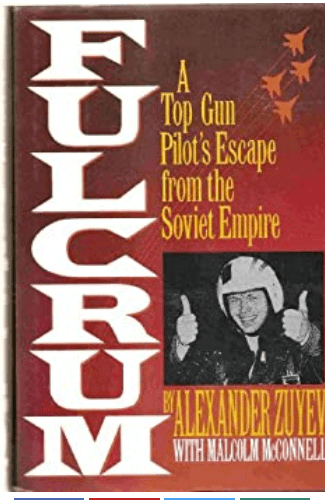
Book Post–Fulcrum: A Top Gun Pilot’s Escape from the Soviet Empire

by Alexander Zuyev with Malcom McConnell

Captain Alexander Zuyev’s book Flanker highlights his famous (and successful) 1989 defection attempt from the Soviet Union at the brink of its collapse. Zuyev, disillusioned with Gorbachev’s glasnost and perestroika political and economic reforms, flew his state-of-the-art MiG-29 fighter jet from his base in Georgia to Turkey, an American NATO ally. Although the fighter was released back to the Soviets, Zuyev himself was granted political asylum in the US, delivering an unprecedented view of not only the Soviet Union’s military readiness at the end of the Cold War, but also of the suffering of the Soviet people in their every day lives. Overall, Zuyev would argue that it was not his lack of patriotism that led him to defect. Rather, Zuyev points out that defection was his own personal rebellion against a system that only served to benefit the ruling elite at stark contrast to the Union’s espoused Socialist ideals.

At its core, Fulcrum (named after the NATO reporting identifier for the MiG-29) is the tale of one man’s confrontation with a fundamental choice: whether to put up with and accept a system that one believes to be unjust (and hope for gradual change), or to strike out and take a stand that could be potentially ruinous (and not just to the individual). Indeed, Zuyev himself admits that once he decided to defect, “my life was no longer balances on a tochka opori, a fulcrum. The balance had tipped. I had made a decision” (Zuyev, 299).

I suppose it was timely that I finished this book on the same week of what I am sure will be known to history as the infamous Capitol Hill Insurrection of 6 January 2021. Regardless of the reader’s opinions as to the merits of the rioting and murder of a Capitol Policeman (Spoiler: It was super wrong), the rioters themselves would have likely found common cause with Zuyev beyond both of their avowed pledges to stand against Socialism (with the scary capital S). The rioters, egged on then-President Trump, viewed themselves as being presented with a choice: accept the results of the 2020 election, or stand and fight to remove the sitting members voting not to prolong the election drama with an objectively unjustified audit.

The crowd’s response was wrong, but it was not un-American. The United States is perhaps the most ideologically individualistic country in the world. With only a few exceptions (looking at you France), the United States has the citizens with the greatest willingness to turn out and join a demonstration. Racial (Ferguson/BLM), economic (Occupy), social (women’s), environmental (climate change), and political (unite the right) have garnered significant turn out and media attention within the United States in recent years. Perhaps this phenomenon is due to the rise of social media or political polarization or increased “wokeness” or delusion. Perhaps it is due to billionaire conspiracies or foreign influence campaigns. Perhaps we are all now, more than ever, looking for something to join, to be a part of. Something that makes us feel like we matter in a world that is getting faster and faster and leaving more and more of us behind.

Regardless of the root cause, the average American today faces the fundamental “Zuyev decision” on a nearly daily basis. For each cause or fight that pops up in a Reddit thread, newsfeed, or FOX NEWS ALERT!1!!! each American asks themselves “will I stand up against this?” I wonder what the effects of such constant buffeting of our moral compasses will be in the long term: Will Americans be more introspective and conscientious, ready to fight for what they believe? Or will Americans become fatigued, over-stimulated, and more than ever willing to sit down in the face of (perceived) gross injustices if it just meant they could get back to their regularly-scheduled lives. I’d argue for the former, although I’m not so certain it is necessarily a good thing.

To determine if it is or not, one should consider the benefits of having increasingly active Revolutionary and Reactionary political activists. Does increased pressure from the wings (however justified one’s cause might be) make for a BETTER United States? That answer depends on what one’s definition of “better” is. More stable, more free, more equal, more powerful? Ask a thousand people and you get a thousand different answers. Another lurking, more seemingly un-American question to ask is if more people passionately involved in political causes is a good thing. Can the common (wo)man be relied upon to be guided with an informed mindset? Or is it more likely that with increased participation comes an increase in the amount of people who are manipulated and swayed by unreasonable passion/emotion?

The Founding Fathers were concerned about this very issue and were largely pessimistic in this regard. A fundamental tenant of our Republic is an inherent distrust of a “mob” and rushes to progress. Instead of a Democracy, they argued, the larger decisions should be made by learned gentlemen who are trusted the Republic’s political establishment/elite to be capable make such choices for the Greatest Good. However, this concept was abruptly ruined by the populism and corruption of Andrew Jackson within 50 years.

So what to do? Clearly, the United States has jumped all over the political compass (https://www.politicalcompass.org/) and will continue to do so in the future with ever greater participation and passion from the extremes which, combined with statistically-proven increasing polarization, will lead to greater volatility.

So how did we move from discussing a book about the theft of an advanced Soviet fighter and the defection of a pilot to discussing the broad movements of political thought in the US today? The answer lies in each of our fulcrums–how and what will make us pivot depends on hundreds of considerations unique to each of us. But truth be told, its a safe bet to assume that all of us will have our fulcrums tested in the coming years.

Thoughts? Please comment below!